
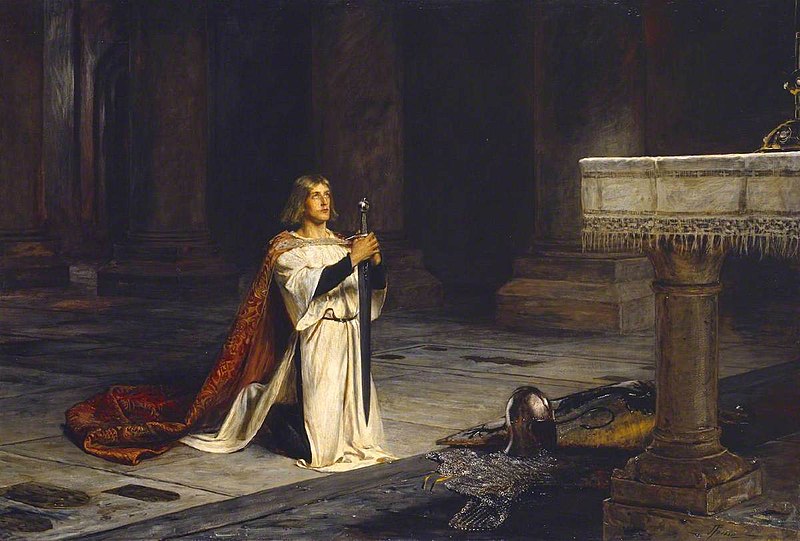
“This above all, ~ to thine own self be true; and it must follow, as the night the day, thou canst not then be false to any man.”
Our true self is what we are in God’s mind, what He wishes us to be in our day and generation, so as most to benefit the world amid which His design has placed us. Let each man of us learn to be, and set himself manfully to be an,
“Active doer, noble liver, Strong to labor, sure to conquer,”
and we shall not only fill our place well in Church and State, but help to our utmost, to make the present age hold a glorious place in the annals of the world.
The great need of the present day is men of great character. And by character I mean the firm habitual disposition to truthfulness, honor, integrity, generosity and resolute energy of purpose, without which no man ever was or can be a true man. These qualities are formed in the child by teaching and still more by the example of his parents. Truthfulness, integrity and goodness form the essence of manly character, or as a distinguished writer has it, inbred loyalty unto virtue, which can serve her without a livery. He is strong to do good, strong to resist evil and strong to bear up under difficulty and misfortune.
And speaking of honor, the bright crown of all manly character the poet but expresses the sentiment of the Church in these lines:
“The purest treasure mortal times afford
Is — spotless reputation, — that away,
Men are but gilded loam, painted clay.
A jewel in a ten-times barred up chest
Is a bold spirit in a loyal breast.
Mine honor is my life; both grow in one;
Take honor from me, and life is done.”
But we must not confound what is here called honor with mere fame; there were and there are many of the noblest souls, who are as careless of what men may think of them as they are jealous of the testimony of their own conscience and anxious to stand well in the secret judgment of the All-seeing God.
There is nothing that cannot be endured, save dishonor, says the great St. Martin of the Fourth century ; observe therefore your own actions and do not be care less about them because they are hidden from the public eye; for it matters but little that none behold them, since you are a witness to them yourself. It is the precious quality of a great soul, not to be vacillating, but ever consistent with oneself and fearlessly hopeful of the end of life.
The Catholic conception of honor is spotless integrity in the sight of God, much more even than an unstained reputation in the judgment of the world. The former is the sure foundation of the latter; — and it is chiefly about it that every true man should be concerned. If we are without reproach before our own conscience and in the presence of God, there can be but little fear for our good name among men.
Supreme and loving reverence for the Divine Majesty, and the filial fear of rendering oneself displeasing to Him, — such is the habitual sense of the Christian soul that helps to keep it free from every secret stain. It is the fear of the Lord under another name. And where it possesses the heart of man, it is impossible that it should not preserve his outward life from voluntary stain. The purity and hardness of the diamond belong to the very first particles which unite at its heart’s core; the others which the mysterious laws of the Creator attract around these to in crease and perfect the beauteous crystalline mass must needs share the qualities of the former. The light which fills it, the perfect purity which gives even that light its highest value, belong to the very heart of the gem. The most beautiful, the most manly, the most heroic characters in the esteem of a rightly judging world, are men whose hearts have never lost their personal purity, souls in whose very center the fire of God’s love lives unquenchably and whose lives shine with undimmed and surpassing splendor only because from childhood to the grave they “walked by His light in darkness.”
The nobility of soul, of which I speak here, is the joint product of God’s grace and our own generous cooperation. Parents can and do contribute greatly toward the creation of this nobility of soul and conduct; it is, speaking under God, the result of one’s own fidelity to the Divine Voice ever speaking in conscience, to the Divine Light ever showing steadily the path of duty and honor, and to the impulse of the Divine Spirit urging the boy of the beggar as well as the boy of the prince to aim high, and do nobly and be in all things true to the light and the truth within them.
“I have neither riches nor power, nor birth to recommend me; yet, if I live, I trust I shall not be of less service to manhood and my friends, than if I had been born with these advantages.” Thus at the age of twenty spoke a poor lad who had been brought up in the shop of his father, and who was when he wrote these words in his diary, a druggist’s apprentice. The world knows to what a height of pure fame he attained by dint of heroic labor, while the laborious life found its fittest and sweetest reward in the peace and blessing of the Church of his fathers which took the weary traveler to her embrace.
It is conduct, that manifests “the active doer, noble liver.” Do the work you have to do bravely and well. The disposition to seek to be perfect in everything to which one sets one’s hand, to make the most of the task allotted for the present day and hour, is a divine instinct, which if followed faithfully, will lead to certain eminence, to eminence in learning, in wealth, or in statesmanship; to eminence in art, in eloquence, or in sanctity, according to one’s chosen sphere of labor.
Look forth upon the various walks of life, in Church or State; you will find that the men most eminent and most honored in every profession and employment are the men who have put their heart in their work, — who have begun with the determination to do as did the great king of Juda, who, “wrought that which was good and right and truthful before the Lord his God, — desiring to seek his God with all his heart; and he did it, and prospered.
“McKinley would not have become president if he had not previously been a zealous teacher, a responsible soldier, a conscientious statesman. Neither Lincoln nor Grant started as a baby with a precocity for the White House, or an irresistible genius for ruling men. So no one should be disappointed because he was not endowed with tremendous gifts in the cradle. His business is to do the best he can, wherever his lot may be cast, and advance at every honorable opportunity in the direction towards which the inward monitor, his conscience, points. Let duty be the guiding star and success will surely be the crown, to the full measure of one’s industry and ability.”
And let me say to the young men in particular, do not wait for opportunities. You would only resemble the stolid traveler in the fable who having come to a river which lay in his path, sat down on the bank till all the water shall have flowed by. You would seek for a fairy, or make a raft on which to cross.
God gives man the power of invention to enable him to find resources against the difficulties which impede his progress. The difficulty itself is often the most golden opportunity. At any rate men of resolute temper seek and find or make their opportunities, just as the industrious farmer often makes the very soil on which he grows his crops. Opportunities! Why, life is one grand continuous opportunity from infancy to our latest day. The conscientious, the resolute, and the thrifty turn each hour into golden treasures ; — the listless, the stolid, the sensual, like our Indians, allow teeming mines to lie idle at their feet, with countless treasures unknown, unappreciated, undeveloped.
Give us, therefore, in the conduct of life, men who have a purpose, who know what they have to do, and are determined to succeed; whose firm trust in God above them only increases their faith in themselves; men who neglect nothing; who constantly discipline their own minds, their own hearts and exercise over their own powers and passions a sovereign control; men whose watchword in all their undertakings and difficulties, in all their alternations of bearing and forbearing, is duty; and who in their labors, their successes, their failures, find themselves superior to fatigue, to good or ill luck, to praise or to blame, — because they begin and persevere and hope through a sense of duty, — of a sacred debt due to God and their own conscience.
Surely there is great need of such men in our day. And because they are thus dutiful and true, — they will be diligent, laborious, persevering, self denying and self reliant, because placing their main dependence on God and putting forth to please Him, in their every work and endeavor, their whole strength and industry, such men are, — everything taken into account, — the best calculated to succeed. And such men, — be they born ever so lowly, are God’s true noblemen, — the men whom all are forced to respect, — because they are incapable of meanness, fraud, baseness, or untruthfulness. These are some of the features of the true Catholic Forester; true men so needed at all times but especially now. Such men are God’s noblemen. This court should be a model one, made up of men of character, men of Christian manhood. Let it be known far and wide that to be a member of this court a man must be a practical Catholic in the true and only sense of the term. A practical Catholic is one who faithfully and devoutly attends Mass every Sunday and Holy Day of Obligation; who loves to frequent the sacraments, because it is only there he can obtain the strength to fight the battle of life; who takes an active interest in the welfare of his parish and gladly contributes his full share towards defraying the expenses of his parish; who loves the Church as his Mother and rejoices in her triumphs and is saddened at her reverses; for no one can love God and not love the Church, just as no one can have God for his Father who has not the Church for his Mother. Oh, for men of true Christian man hood. Men who are able at all times and in all places, to stand up for their faith and by their irreproachable conduct command the respect of all. We are told that Diogenes sought with a lantern at noontide in ancient Athens for a perfectly honest man, and sought in vain. In the marketplace he cried aloud, “Hear me, O men”; and, when a crowd collected around him, he said scornfully, “I called for men, not pygmies.” The world has a standing advertisement over the door of every profession; every occupation; every calling; “Wanted a True Man.”
Wanted a man who will not lose his individuality in a crowd, a man who has the courage of his convictions, who is not afraid to say, “No,” though all the world says, “Yes.”
God calls a man to be upright and pure and generous, but he calls him also to be intelligent and skillful and strong and brave.
“If the youth,” to quote a learned author, “should start out with the fixed determination that every state ment that he makes shall be the truth; that every promise that he makes shall be redeemed to the letter; that every appointment shall be kept with the strictest faithfulness and with full regard of other men’s time; if he should hold his faith, his reputation as a priceless treasure, feel that the eyes of the world are upon him, that he must not deviate a hair’s breadth from the truth and right; if he should take such a stand at the outset, he would come to have almost unlimited credit and the confidence of all, and would develop into a noble man.
What are palaces, what are equipages, what though a man could cover a continent with his title deeds or an ocean with his commerce, compared with a conscious rectitude, with a face that never turns pale at the accuser’s voice, with a bosom that never throbs with the fear of exposure, with a heart that might be turned inside out and disclose no stain of dishonor? To have borne no man a wrong; to be true to the faith to which we have sworn solemn allegiance; to have put your signature to no paper to which the purest angel in Heaven might not have been an attesting witness; to walk and to live unseduced within an arm’s length of what is not our own, with nothing between our desire and its gratification but the invisible law of rectitude — this is to be a man.
” The wisest man could ask no more of God Than to be simple, modest, manly, true.”
Amen.

The Beauty and Truth of the Catholic Church Vol. 5 (1916)
Rev. Edward Jones
Leave a Reply