
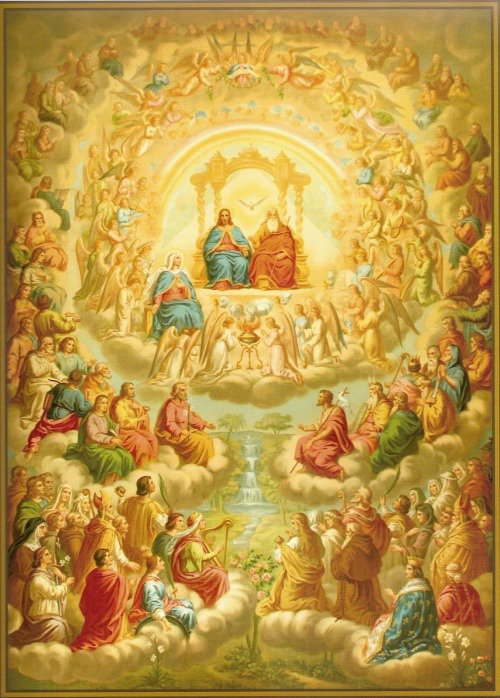
“Eye hath not seen, nor ear heard, neither hath it entered into the heart of man, what things God hath prepared for them that love Him.” — 1 COR. 2, 9.
The laws imposed upon man by the Creator are the commands of wisdom and supreme order. They are the conditions of his living out the fullness of his being, and of his attainment of the destiny which is marked out for him in the counsels of the Infinite. This destiny attained, happiness is his lot, and in this happiness he receives the reward of righteous conduct.
What then is for man the fullness of being? What is his true life, the beginning of which is given on earth, the rich fruitage of which comes to him in the country beyond the grave? Man’s true life enjoyed in its completeness — this is eternal life.
Man’s true life is in his highest and noblest faculties, the intellect and the will — the intellect reaching out to truth, the will embracing it and adhering to it. Man comes under our notice as a bundle of varied faculties, powers and senses. Among these we must distinguish those which belong to the soul, as a spiritual being, differentiating man from the lower creation, and those which are common to him with the animal and material worlds; we must distinguish that which is permanent in him; and that which is temporary, serving only transient purposes. Vegetative and animal life is not man’s proper life: the things which minister to it, earthly possessions, earthly enjoyments are not the proper objects of his longings and aspirations. Man is a rational being; intellect is his chief, his peculiar faculty — intellect is the power to know, to seek out truth, and to apprehend it.
What is truth? Truth is being: whatever is, is truth, and is the objective matter upon which the intellect is exercised. Being, apprehended as truth by the intellect, presents itself to the will of man as goodness. For whatever is, is, so far as it is being, good in itself and desirable to man. To complete the philosophy of being, I must add that all being at the same time that it is truth and goodness, is also beauty, or rather it is beauty because it is truth and goodness. Being is beautiful inasmuch as it charms the soul, and pours into it joy and contentment.
Now the soul consists essentially of those higher faculties of reaching out to what being there is, under its several aspects of truth and goodness and beauty, and necessarily we find in those faculties of the soul man’s true life. I am aware that I am speaking a language difficult to be understood. In our present state the material and the animal overpower us. They darken our interior light: so that we scarcely see the supersensible; they occupy us, they distress us by their imperious demands, so that we almost forget the higher life, and when mention is made of it, the messenger hails, as it were, from an unknown country with which we have but slight concern and in which we scarcely believe that we could be satisfied. Nevertheless when we at all reason upon things, we perceive clearly that material and animal surroundings and requirements are really things transient, things extrinsic to the soul, or spiritual nature, things accidental and conditional. We are first of all and above all, souls, reasoning and thinking creatures whose chief faculty to see things out side of self is intellect and whose true life is and must be the sequences of the exercise of intellect.
All that is, is truth, goodness and beauty. The universe is being, and man’s soul goes out to it, to behold, love and admire. But what are its perfections but rays from the Incarnate Deity? The soul is not satisfied with knowing effects, without knowing the cause: it is not satisfied with the finite, and limited, without reaching up to the Infinite Himself. God is Being infinite, supreme, Truth, Goodness and Beauty, and towards Him are the soul’s longings. He is the Alpha and the Omega of all creation, the beginning and the end of all creatures. Inferior creatures reach Him through man whom they serve; but man himself is so great that, endowed with the supernal wings of intellect and will, he soars directly unto the throne of the Almighty. Man’s soul descends from God, and having lived out its life, rises again upward to the bosom of Divine Immensity. In the words of St. Augustine: “Our souls, O God, are made for Thee, and there is no rest until they repose in Thee.”
Where is the fullness of life to be found? It is manifest that we have not this fullness of life in our present condition. We are in a state of longing, of unrest, of struggling, seeking what we need, and what we do not possess. We are not in a state of happiness. Happiness is a signal of our arrival in our native home where all is possessed that has been hoped for, that the soul has sighed for. Its fullness comes upon the at tainment of our destiny. It is complete satiation of longings, the fulfillment of desires, the reflection of the soul with all the good that it is capable of, the effacement of all emptiness in intellect and in will.
Happiness! Magic word which we all understand so well, because we all are driven by our natures to court it, and we have it not. The all-wise Creator as signing to a creature a purpose, a destiny, fashions the creature for if, and makes that the whole being should be impelled toward it, and no rest allowed away from it. Will the magnetised needle cease its troublous rotations until it faces the polar star? Neither will my soul rest, O God, away from Thee! “As the hart panteth after the fountain of water, so my soul panteth after Thee, O God.” “My soul hath thirsted after the strong living God, when shall I come and appear before the face of my God?” But upon earth “we see through a glass, in a dark manner,” ” we know in part.” We perceive God only through His works, and even so, in a manner most imperfect. The soul is not and cannot be satisfied. Nor will earthly goods themselves fill the vast sea-bed of our longings. They at best are limited, variable, perishable. Either they are not given, or they are given with stint, or they tire when possessed, or threatening to flee away, alarm in the midst of possession and enjoyment. We are not happy on earth, “for we have not here a lasting city, but we seek one that is to come.”
Heaven! This is the sweet word that tells of the coming city, and of coming happiness. In Heaven we shall see God ; no longer in His works, but in Himself : no longer through a glass in a dark manner, “but face to face.” Seeing God the soul shall unite itself most intimately with God in love, and possessing Him, it shall be charmed with His supreme beauty and inundated with joys unspeakable.
The plain fact about Heaven which we learn from Divine Revelation is that we shall see God face to face. It is this immediate seeing of God’s Being that theologians call the beatific or intuitive vision. Reve lation, therefore, is in accord with our own reasoning in putting man’s true life in the exercise of his noblest faculties, and in placing before us the object of this exercise, Infinite Being, Supreme Beauty, etc.
St. Paul says: “We now see through a glass in a dark manner, but then face to face.” “Now I know in part, but then I shall know even as I am known.” And St. John : “We are now the sons of God, but it doth not appear yet what we shall be. We know that when he shall appear we shall be like him because we shall see him as he is.” Our Lord Himself says: “The angels in heaven always see the face of my Father,” and elsewhere we are told by Him that the just shall be as the angels, “this is eternal life,” He says, ” that they might know thee, the only true God, and Jesus Christ whom thou hast sent.”
” We shall be like to God.” The natural law of environment will work out a similarity of life and being in us with the life and being of God. We are created to His image and likeness, but now the image in us is dim. When, however, the soul, penetrated with divine grace, is exposed to the full splendors of God’s majesty, this image within us is brought out in all its richest colorings. Living continuously in the presence of God, the soul is transfused with divine light, and becomes holy, pure, resplendent of God’s own holiness, purity and beauty. The life of the beatified soul is of the same kind as God’s own life, which is to know and love His own eternal essence; and the happiness which comes from the eternal vision of His own In finite perfections. Hence the Judge says to the just: “Enter into the joys of the Lord.”
Our trials and tribulations shall be forever ended and all that properly belongs to our being shall be accorded to it. All that shall be required for our bliss unimpaired shall be granted, and this bliss shall be unspeakably great in measure and everlasting in duration. As to the measure St. Paul writes : “That eye hath not seen, nor ear heard, neither hath it entered into the heart of man what things God hath prepared for those who love him.”
Why, with these words before us, should we assay in plain words or brilliant metaphors to describe the joys of Heaven? It is enough to know that God shall be our inheritance, that His love and omnipotence shall be at our disposal. And then the certainty, that all these joys shall never have an end! “The just shall
go into everlasting life.” Hope alone, even now, fills our hearts with sweetest comforts; what shall not be fruition of the realities.
What is of immediate importance to us is to shape our present conduct, so that the termination of life upon earth be for us the beginning of the life of Heaven. Thither are we called. All men have been made for happiness in the vision and possession of God. But not all reach Heaven, for not all take the road to Heaven or fit themselves for its blessedness. “There shall not enter into Heaven anything defiled or that worketh abomination, or maketh a lie, but they who are written in the book of life, of the Lamb.” Only the God-like soul could live the life of God. To be able to know, love and serve Him in Heaven, one must learn to know, love and serve Him on earth. How slight the attention given to those duties! We study earth and sky ; we read one question, we reflect, in order to be proficient in branches of human knowledge. But as to the knowledge of God, and of His revelation, we give in seeking it, but little, if any time. How vague and indefinite is our knowledge of what God requires from us, of the means of salvation which He has put at our disposal, of the commandments which He has imposed upon us! lt We do as well as we know,” is a common expression upon our lips ! But I ask, have we studiously and earnestly striven to know? Have we observed every flash of light that passes across the mind, and have we followed its lead, that we might discover its full duty? And when we do know, have we, preferring God’s will to all things, loyally and unflinchingly obeyed? If instead of God we seek out our own ease and pleasure and follow our own likes and dislikes instead of His divine will, in vain do we aspire to Heaven; it never shall be ours. It was this doctrine of man’s future life, which the Apostles of Christ made the burden of their preaching as they passed through the nations. It was this doctrine which gave the Gospel a claim to be heard when first preached, which arrested the thoughtless multitudes, who were busied in the pleasures and pursuits of life, and awed them with a vision of another life, until they turned to God with a true heart. This doctrine of a future life was the doctrine which broke the power and fascination of paganism. “Let us eat and drink for tomorrow we die,” was the rule of life of the world before Christ. ” To-morrow we die,” this the Apostles admitted; but they added — “and after death the judgment” — judgment upon the eternal soul which lives in spite of the death of the body. Is the world much wiser and better than the world of paganism? It can boast indeed of ten thousand material accomplishments; all these we admit and praise. But of what use are they if men are not brought nearer to the last end? Earth shines out in vain if Heaven recedes the further. ” After death the judgment,” the looking into our record, our life on earth to see whither it has led us, whether to Heaven or to Hell. Whither? — This is for each of us the question of questions. Amen.

The Beauty and Truth of the Catholic Church Vol. 5 (1916)
Rev. Edward Jones
Leave a Reply