

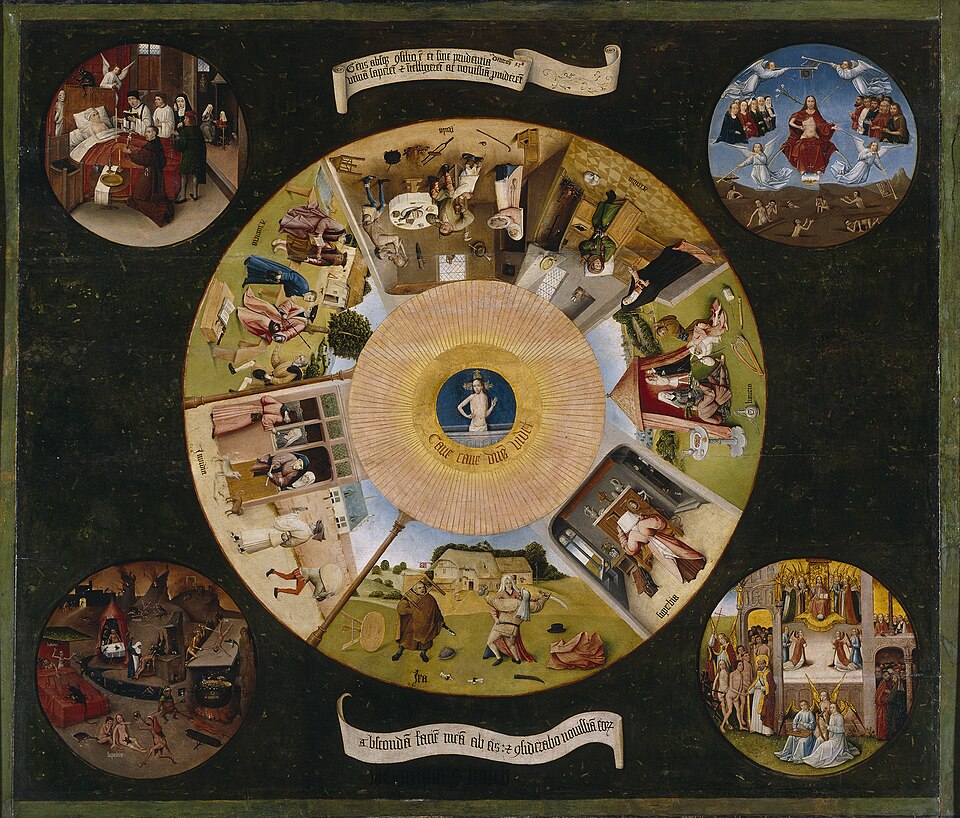
Many Christians try to dissuade themselves from the fear of judgment
They shall see the Son of Man coming in a cloud with great power and majesty,—Luke 21
In reading for us twice a year the gospel on the last judgment, namely, on the first Sunday of Advent and on the last Sunday after Pentecost, the beginning and the end of the Ecclesiastical year, our Holy Mother the Church has, beyond doubt, the intention of frequently calling to our mind the advice in Ecclesiasticus: “In all thy works remember thy last end, and thou shalt never sin.”—7 : 40. For this reason pastors of souls frequently speak of this judgment, describe its severity, show its con- sequences, and direct our attention to the saints, who, though their conscience reproached them with nothing, trembled at the thought of appearing before the tribunal of the omniscient God, there to give an account of even every idle word. And how do many Christians act when they hear of judgment? They remain cold and indifferent, never thinking of changing their worldly, sinful life. And why this indifference? We shall to-day investigate the cause. Many Christians try to dissuade themselves from the fear of judgment by saying,
1. We are not so bad as you would make us think,
II. The judgment is not so rigorous as you describe it to be.
Part I
1. There are some who think themselves better than they really are. Their conscience does not reproach them with great crimes, such as rape, theft, murder, fornication, adultery, etc.; hence they believe that they are good, and have no reason to fear judgment. But how they deceive themselves ! “Man seeth those things that appear, but the Lord beholdeth the heart.” — I Kings 16:7. Exterior righteousness is, indeed, good and necessary for salvation^ but it is not sufficient. The most necessary requisite for holiness is a well-disposed mind, with a heart that hates and detests evil, and sincerely loves God above all things. Where this interior righteousness is wanting, the outward is a dry, shriveled nut without a kernel ; it is tinsel brass, without value. Only consider the Scribes and the Pharisees. Was not their outward conduct blameless, even praiseworthy? They prayed much, fasted austerely, gave alms, and were zealous for the law. But how does Christ, who knew their hearts, judge them? He asserts that with a justice such as that of the Scribes and Pharisees we can never enter into the kingdom of heaven. And why not? Because the Scribes and Pharisees were devoted only to outward justice, whilst they nourished in their hearts the basest passions, such as pride, ambition, hatred, envy. Wherefore our Lord compares them to “whited sepulchres, which outwardly appear to men beautiful, but within are full of dead men’s bones, and of all filthiness” — Matt. 23 : 27. How many a Christian resembles these Scribes and Pharisees! Outwardly his conduct is without fault, without blemish, but how does he look inwardly? How full of wicked, revengeful thoughts, impure desires, vain wishes, ambitious projects? How uncharitable to his fellow-men, especially to those who are of no use to him; what stratagems and tricks he makes use of to undermine their happiness! How inclined to disregard his conscience and the commandments of God when there is a question of the gratification of his passions ! If such a Christian thinks himself righteous, and has no fear of the judgment of God, he woefully deceives himself. O Lord, preserve us from such a justice, which deserves the sentence of damnation!
2. There are Christians who know that they are faulty, but they believe that their good works will cancel their sins and justify them before the tribunal of God. They say their prayers, go regularly to church, get masses said, and give alms. They expect by these pious exercises so to propitiate Almighty God that, notwithstanding many secret sins, as well as open ones, of injustice, backbiting, etc., he will somehow grant them the grace to die penitent, and thus to gain the reward promised the faithful, viz., eternal life. But such persons sadly deceive themselves. As laudable as good works are, without radical penance and amendment of life they have no value before God. Christ himself teaches us this truth in the parable of the vine and the branches. — John 15 : 4, 5. He who lives in the state of sin, and therefore is not united with Christ by sanctifying grace, can do nothing meritorious for heaven, no more than a branch cut off from the vine can bear fruit. If you had the virtues of the greatest saints, and performed works good in themselves without number, yet if you lived in a state of sin, you could not stand before the judgment seat of God. Nay, if you should appear before God with numberless good works, but defiled with only one mortal sin, all your good works would profit you nothing; on account of that one mortal sin you would be damned for ever. Consider this important truth, and be not so foolish as to lull your conscience to sleep by the thought that God, on account of your good works, will overlook your sins. There is no one now in hell who has not done some good, and many a great deal of good, in their lifetime. Nothing defiled can enter heaven ; even the least fault must be atoned lor, either here, or hereafter in purgatory, before the gate of heaven is opened. Be diligent, therefore, in performing good works, but above all, see that your heart is not contaminated with mortal sin.
3. Lastly, there are some who avoid evil, and perform some good works, but they will nevertheless be rejected. And why? Because in avoiding evil and in doing good, they have not God and his holy will in view, but themselves, their own temporal advantage or disadvantage. Whatever is not done from veneration, love, and obedience to God, has no value for heaven. Are you astonished at this assertion ? Suppose, to use a familiar argument, that a la- borer works the whole day, not in your field, but in another man’s, and in the evening comes to you and demands his wages; what would you say? would you not say, Go and ask him to pay you in whose field you have worked? Of course such a laborer could not compel you to pay him. He did not work for you ; you have nothing to do with him or his work. In the same way God cannot be expected to reward us for work not done for him nor according to his will. Therefore Christ says of those who, like hypocrites, give alms, pray, and fast in order to be seen by men, that they have already received their reward. — Matt. 6 : 2—8. Some abstain from impurity, theft, and other vices, but why ? Their motive is ambition, that nobody may be able to say anything against them. Some perform good works and pious exercises, especially works of Christian charity, that they may be praised by men. Some are very active in their avocation ; they work with zeal and diligence and save money, Why? That they may be rich and respected some day. They do not think of God ; for the love of him they move neither hand nor foot. Their motives in doing this or that good, or in avoiding this or that evil, are natural and temporal. How they deceive themselves if they imagine that they will one day be rewarded for these actions. They resemble the man who was continually drawing water and pouring it into a sieve. It would not hold, and he could never fill it. From this you see how ill- advised those are who dissuade themselves from the fear of judgment, because they will not think themselves as bad as they really are. Ah, if even truly pious Christians tremble at the thought of the judgment of God, how is it possible for those who are anything but pious to look forward to that judgment without fear? But some will say, the judgment will not be so rigorous as it is generally described. Let us see what really is the case.
Part II
You may hear careless Christians say: The last judgment will not be half so severe as it is represented to be, for God is good, and will not demand a rigorous account. Doubtless, for many it would be well if it were so, and for their sakes it is a pity that their doctrine is flatly contradicted by Holy Writ and tradition. What will God do with you when you stand before his tribunal ? Will he, perhaps, say: Behold, you are a sinner, and not fit for heaven, first go and confess your sins and be absolved, then I shall judge you. Alas! there will be no confessional at the last judgment; God will judge you as you are when you arrive there ; whether you be good or bad, he will render to you according to your works. — Rom. 2: 6. Tell me: Can God reward the wicked as he does the good? If he can, he is neither holy nor just; not holy, because good and evil would then be all the same to him ; not just, because justice never confers the same reward on good and evil. But it is sheer blasphemy to think thus of God. But you will say: I do not mean this; I grant the holiness and justice of God, but I give his goodness and mercy also their due. I trust in them ; and on account of them I hope that God will not reject me on the day of judgment. You mean to say in other words that as long as you live upon earth, however great a sinner you may be, you hope and trust in the mercy of God, It is true, the mercy of God is infinite and eternal, but for you the application of that mercy must be restricted to time. Your hope and confidence are vain as soon as you extend them beyond the veil of time to the judgment-seat of God. God’s justice alone will sit on the judgment-seat, and do its part unswervingly. As God shall then find you, he will judge you; if you are good, he will admit you into heaven; but if wicked, he will condemn you to hell.
But you will say: // is not in respect to sins of malice and great crimes that I think of God as a gracious judge ; but only with regard to the weakness and frailties to which all men are more or less subject. God, our heavenly Father, will surely not condemn us on account of frailties. Now listen to what I have to say: True, sins of malice are heavier in the scales than sins of frailty, but you must know that sins of frailty also lead to damnation. Was it not a sin of weakness which Heli committed in rearing- his children so badly? and it is the opinion of all that Heli was damned. Was it not a sin of weakness which Peter committed when he denied his Master ? If he had died without doing penance for it, who doubts that he would have perished eternally? Was it not a sin of weakness in Pilate to condemn Jesus to death ? Whither did this sin of weakness conduct Pilate? Into hell. And what do you call sins of weakness or human frailties ? Perhaps your most abominable debaucheries, your ever-returning drunkenness, your appropriation of the goods of others, your curses and blasphemies. If you approach the judgment-seat of God with such frailties you will surely be damned.
2. But another will say: If God will demand so exact an account, no one will be saved. Most people live as we do. God would be obliged then to damn all if he were to damn us, and heaven would be a void. To the first I would reply: It is not true that most Christi- ans live as you do, who speak thus. There are now, as at all times, many who live in the fear and love of God, who never commit a mortal sin; and many more by far who rise again after their fall and do penance. Heaven is for these, and it must be immense to contain so great a number. To the second I reply : God is just, and will remain just, and will reward the good and punish the wicked, no matter how great the number of the latter may be. God will damn millions of men as well as one, if they deserve damnation. Do you not know that God destroyed the whole human race by the deluge, eight souls alone excepted ? And if these eight souls had not been just, they, too, would have perished. Do you not know that all the inhabitants of Sodom and Gomorrha perished by a rain of fire and brimstone, Lot only with his wife and two daughters excepted ?
Let no sinner console himself with the thought : Others are no better than I, God will not condemn me. It is probable that the people of Noe’s time, and the inhabitants of Sodom and Gomorrha, comforted themselves in this manner, but that did not save them, and will save no sinner. Be not therefore of the crowd who live in sin and vice, but foolishly expect to be of the number of the few who walk in the fear of the Lord and in the way of his commandments, for “many are called, but few are chosen.”
3. But some will say: It is certain that Jesus Christ will be our Judge, for we say in the Apostles’ Creed: From thence he shall come to judge the living and the dead. Jesus is all love and mercy, he came to save, not to condemn sinners. He graciously received Mary Magdalen, that public sinner, and forgave all her sins. He graciously received the adulteress and condemned her not ; he even pardoned the thief and murderer on the cross. To this I must reply that such confidence is in contradiction with faith; it is not confidence, but presumption. Jesus is merciful, it is true, but he is merciful only to repentant sinners; he is good to those who are good, or who strive to be good. If Mary Magdalen, and the adulteress, and the thief on the cross, had not been truly penitent, Jesus would have no more forgiven them their sins than he did those of the obdurate Scribes and Pharisees, or those of the other thief on the cross. Does not Christ say: “Unless you do penance you shall all likewise perish?” — Luke 13 : 3. Do you not know that he frequently cried out: “Woe to the Pharisees !” and threatened them with eternal damnation? Moreover, it is certain that the mercy of God rules with a loving sway in this world, but that for those who abuse it, this mercy will in the other world give place to justice.
Peroration
Consider all this earnestly, and be not deceived by men who make God like Heli, who was all mercy and indulgence, and had hands only to reward, but none to punish. God’s judgment is strict, so strict that we must give an account of every idle word. —Matt. 12:36. “If the just man shall scarcely be saved, where shall the ungodly and the sinner appear?” — I. Peter 4: 18. Be not satisfied with an apparent justice, which may suffice before the world, but will not avail before God. Avoid every sin, even the smallest, and if you have sinned, reconcile yourselves with God by true, genuine penance. Make good use of the graces which Jesus procured for you at his first coming for your salvation, that you may look forward to his second coming with joy and a well-grounded hope of his being a gracious Judge. Amen.

Taken from The Pulpit Orator Volume 1
By The Rev. John Evangelist Zollner
Leave a Reply