
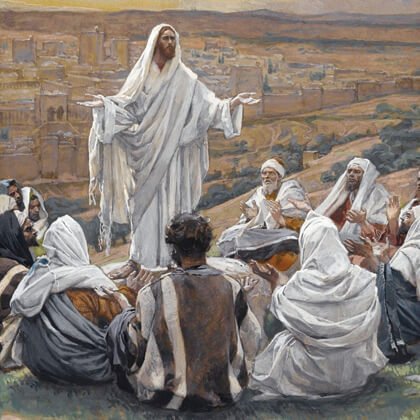
“You shall lament and weep, but the world shall rejoice.”–John 16.
When Lucifer, with his followers, rebelled against his Maker, the kingdom of the angels became divided into two parts the good angels, or those who had remained faithful, forming one; the fallen angels, or those who had rebelled, the other. So, too, from the time of our first parents, the human race has in like manner been divided into two classes the faithful, who were called the children of God; and the followers of Cain, called the children of men. These two classes have ever been directly opposed to each other. The children of men seek the goods of this world; the children of God, those of the world to come. The former work for what is temporal, the latter for that which is eternal. The children of this world, on the one hand, following their own will, gratify every desire; while, on the other, the children of God, wishing in all things to accomplish the designs of God, submit cheerfully to every trial, and of their own accord crucify their flesh and its concupiscences.
And if the life of the good Christian differs so much from that of the bad, what, think you, must the difference be in the future that awaits them? The sadness of the children of God will soon be changed into eternal joy; but the joy of the children of the world into sorrow and weeping.
It is to this contrast, my brethren, that I wish to draw your attention today. Mary, obtain for us the grace so to grieve with thee and thy divine Son upon earth as to rejoice with you forever in heaven. I speak in the most holy name of Jesus, to the greater glory of God!
“You shall lament and weep, but the world shall rejoice.” It was for the encouragement of His Apostles that Christ uttered this prophecy. He foresaw the sufferings they would undergo for His name, and it was His wish that trials should not come unexpected, but that they should be well prepared for them. He warned them of tribulations and persecutions, and in their persons He spoke to all Christians who, like them, would have to take up their cross daily and follow their crucified Master.
Yet He wished them to understand that it would be only for a little while, and He said: “A little while, and you shall not see Me; and again a little while, and you shall see Me. I will see you again, and your heart shall rejoice; and your joy no man shall take from you.”
“A little while, and you shall see Me.” A little while! “What does it mean?” asked the Apostles.
Be courageous and confident, He seems to say to them; the time of trial will soon pass away, and then I shall be your reward for an eternity. “You shall lament and weep, but the wicked shall rejoice;” but do not, on this account, despond, for the triumph of the wicked shall be short-lived, and the day will presently dawn that will secure for you the reward of all your labors. Truly, two small words, yet how full of instruction and of consolation!
“You shall lament,” said Christ to His Apostles; and, through them, to us also, who glory in being Christians, and who are desirous of imitating their virtues. And ever since the fall of Adam, has not this world been a land of exile to the children of God? To what persecutions have they not been subjected by the children of this world and the powers of darkness? How sad has been their lot on earth, and in what sorrow have they not passed their days!
Were! we to look no further than the present life, our grief, I grant it, would be inconsolable; but as Christians, followers of Christ, holding from on high the precious gift of faith, we must view the cross in the supernatural light of that faith, which teaches us that these sorrows will soon pass away, and a happy eternity succeed them. Now, what is it that causes us most sorrow? Let us examine it closely, and we shall see clearly that all we suffer is permitted by God for His own greater glory, and our future good.
In the first place, it may be that we are poor, or have become so suddenly by what seems to us a caprice of fortune. Here is one who was once wealthy; today he finds it difficult to earn the bread necessary for the support of himself and family. You are sad and oppressed with anxiety, because you see those near and dear to you obliged to suffer from want, or at least deprived of that contentment they once enjoyed. Or again, your honor may have been assailed. You were once courted and esteemed, respected by all. But a day came when calumny stripped you of your good name, to be prized above all riches; and from that time those who, perhaps, had once greeted you from afar, now shunned your very approach. Or you are in grief, it may be, for the loss of your health; formerly, you were strong and active, but you have been stricken down with paralysis, or your lungs are hopelessly gone. Finally, death may have visited a happy home, and taken a beloved wife, a loving and hopeful son or daughter, and you are now alone. Your friends, perhaps your family, have abandoned you, and there is no one to speak a word of consolation to you in your sorrow. And so for some one of these reasons you weep, and feel life a burden.
But how soon is not this sorrow changed into joy when, enlightened by faith, we consider the words of Christ: “A little while, and you shall see Me!”
Why mourn the loss of temporal goods? A Christian should prize what is eternal. What is the world and all its riches compared with heaven and God? And this is the promise made to the poor in spirit, if during this short life they support, for the love of God, whatever affliction it may please Him to send them. Even were the time of life not so short, but like that of Methusala, prolonged to a thousand years, yet, in comparison with eternity, such a life would not deserve to be called a moment.
You have been robbed by calumny of your honor, and you are now an object of contempt and ridicule. But what is honor? Whatever it may be in itself, if by retaining it we should lose heaven, how unworthy of our aspirations would it not become! Are we to prefer the honor bestowed on us by men to that which God has in store for us? Who, my brethren, are they that honor us, and what do they honor in us? They are themselves miserable; sinners, and, perhaps, more worthy of being despised than we are. But who is to say that we are worthy of honor? One thing is certain, if our faults were known to men as they are to God, far from any one honoring us, on the contrary all would despise us.
But we must rise; above the esteem or contempt of men; what they may say or think of us will one day avail us little, if we be not at the same time pleasing in the eyes of God. Moreover, this honor bestowed by man vanishes, while that which will accrue to us by our humility and faithfulness in the service of God will soon develop itself, notwithstanding the contempt of men, into the infinite glory of the blessed, and will remain with us forever.
You have lost your health, and your days are spent in sorrow on that account; but do not lose courage. Man is soon freed from all suffering; a little patience in adversity will sweeten the bitterness of your cup of sorrow, shorten your purgatory in the next life, and furnish countless opportunities of adding new jewels to that crown of glory which you will one day receive. Soon in a little while you shall receive a glorified body. The sufferings of a mortal body must necessarily be of short duration, the joy of a body glorified is never-ending.
And what is death that it should afflict you so much? In reality you never die, for your soul is immortal. Perhaps it is the separation from others which grieves you? Bear it with patience and resignation; soon you will be united in heaven to Christ, and to His Blessed Mother, to the angels and saints, and to those from whom you were separated here below.
Is it not true, then, my brethren, that we have very little reason to complain, whatever be the sufferings we endure? See how transitory they all are; whereas, the cheerful resignation with which we see the will of God perfectly carried out in our regard, will merit for us the glory of a blissful eternity.
With these thoughts ever present to our minds, our life will never be without some consolation; and, even in this world, we shall begin to send up those hallelujahs and hymns of praise which we shall continue to sing for all eternity! Amen!

Original, short and practical sermons for every Sunday of the ecclesiastical year
~Father F.X Weninge
Leave a Reply