
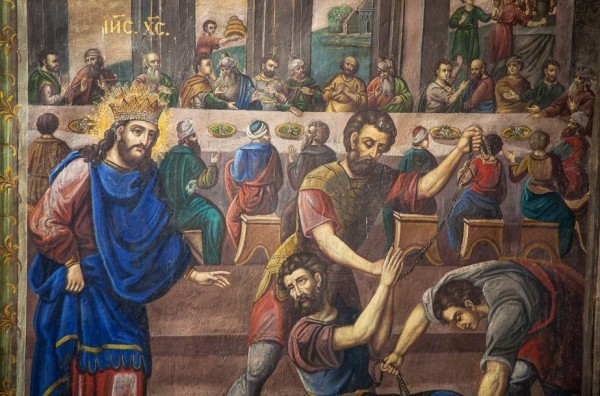
And he sent his servants,
to call them that were invited to the marriage:
and they would not come.
—St. Matthew xxii. 3.
We cannot for a moment hesitate, my dear brethren, as to who is represented, in this parable of our Lord, by the king who made a marriage for his son. It is God the Father; and it is his Divine Son for whom he has made the marriage. And that marriage is the union of our human nature with his divinity; it is what we call the Incarnation. And those who were first invited to this marriage, to partake of its benefits, are the Jews, who were first called to the church, to whom alone our Lord himself preached, and who were the first objects of the labors of his apostles; but who would not answer the invitation, even persecuting and putting to death those who gave it, and thus causing it to be given to others—that is, to ourselves—the city of Jerusalem being at the same time destroyed, together with the national existence of the Jewish people, as a punishment for their rejection of the Gospel invitation.
We Gentiles have accepted what they, his chosen people, refused. We have come by faith and holy baptism to this marriage of the King’s Son, for we are within the fold of his Holy Catholic Church. But having done so, we are now all invited to sit down at the marriage feast. It does not satisfy his love for us that we should simply be within the four walls of his house; he wishes that we should also partake of the good things which he has prepared in it for the refreshment of our soul—that is to say, the special graces which come to us only by means of the church, and which are not found outside: particularly the sacraments, and, most of all, the great and wonderful Sacrament of the Altar, in which he has given us his Precious Body and Blood for the food of our souls.
This, then, is pre-eminently the marriage feast of which he has invited us to partake, now that we are within his house. It is the Holy Communion. One would think we would be only too glad to do so. You would not expect to find wedding guests insulting their host by refusing to taste of the refreshment prepared for them.
But how is it in fact? As he has had to send all over the world by his messengers, the apostles and their successors, through its highways and byways, to find people, not rich and great, as he might expect, but poor, humble, and despised, to fill up his house, so he has to send round among those guests whom he has secured, to beg them to eat at his table. He has been obliged not only to ask them but to entreat them, and even to command them, under penalty of being turned out of his doors by excommunication, if they refuse. And in spite of all this, there are so many that do refuse that he does not carry out this threat, lest even his house should be deserted.
Is not this a shame? Is it not too bad that we, his miserable and unworthy guests, who have no right to be in his church at all, should have to be compelled to receive the food which he has prepared for us in it? More especially when we remember what that food is; that it is himself, his own Body and Blood; for such is his love that nothing else seemed to him good enough for us.
Here it is, this royal banquet, waiting for us all. Every day we are allowed to receive it. And yet how few there are who do so! If any one should go to Holy Communion once a month he is regarded rather as presumptuous than obedient. In spite of our Lord’s repeated request, his people do not seem to believe that it is his will that not only a few but all of them should frequently come to receive him in this sacrament of his love.
Of course, if you are to do his will in this matter, you must in others too. This feast is not for those who continually and obstinately break his laws. But how often you can approach it is a question for those to whom it has been entrusted to decide. Let the responsibility rest on your confessor, not on yourself. Do not let it be said that you, who are invited, will not come. Let not our Lord have to reproach you with ingratitude. Let not his table be deserted through your fault. The communion-rail is the place for all, not for a few. Come, then, often to it, if not for your own sakes, at least for the sake of Him who so longs to see you there and who has done so much for you.
Five Minute Sermons for Low Masses on All Sundays of the Year
Volume 1
Imprimatur 1879
Leave a Reply