
We have seen that the dignity of man as man, as husband, as father and as head of the family is very great. Let us now consider the sublime dignity of woman as wife, as manager of the family, and as mother.
To be a wife, a house-keeper, and mother, is the destiny of woman. To that destiny all her instincts point, and for it God has especially qualified her.
There was not a creature in the teeming earth, the blue expanse, the deep waters, but had found a mate. The first man stood alone in solitary glory, a creature isolated from all other creatures by a higher nature. His great want was that of another being like himself. Hence, the Creator of heaven and earth said: “It is not good for man to be alone; let us make him a help like unto himself. Then the Lord cast a deep sleep upon Adam ; and when he was fast asleep, he took one of his ribs and built it into a woman, and brought her to Adam. And Adam said : This is bone of my bones, and flesh of my flesh. She shall be called woman, because she was taken out of man. Wherefore, a man shall leave father and mother, and shall cleave to his wife; and they shall be two in one flesh.”7 (Gen. ii.; 18, 21-25.) It is thus that the Universal Parent made woman, brought her and the man together, and instituted marriage in Paradise when our first parents were innocent virgins. God himself acted as High Priest on the occasion of the first marriage of one man to one woman. Now God declared woman’s vocation and dignity when he said : “I will make him a helpmate.” Had God intended to create merely a companion of man, capable of following the same pursuits, and capable of the same gigantic labors that are evidently meant to be man’s destiny, why, he would have made another man. But no! when God caused a deep sleep to fall upon Adam, he took out one of his ribs and made a woman — a being in every way the complement of man.
The man alone is not sufficient of himself; nor is the woman sufficient of herself. God distributed the habits of the intellect, of the affections and of the body between the two sexes, so that what is wanting in the one is compensated for in the other.
The man is able to conceive vast ideas and to treat the external relations of the family; he is incapable of descending to the minute details of domestic affairs. The woman can manage domestic affairs and govern the house, but, as a rule, has little capacity to conceive great undertakings.
The man is robust and loves risk; the woman is timid and calculating. The man is inclined to sternness and violence; the woman is mild and gentle and amiable, and a centre of attraction at the family hearth. It is only in the union of these two temperaments that excesses compensate for defects and a perfect equilibrium and harmonious whole is formed.
The woman was given to be with the husband, not given to him. “The woman,” said Adam to God, “that thou gavest to be with me.” She was not to be his slave, nor the victim of caprice and violence, nor the toy of an hour, but a partner in all that concerned him — the sharer of his joy and sorrow, of his prosperity and his afflictions.
As the vine, which has long twined its graceful foliage about the oak, and been lifted up by it into sunshine, will, when the hardy plant is rifted by the thunderbolt, cling round it with its caressing tendrils, and bind up its shattered boughs; so is it beautifully ordered by Providence that woman, who is the mere dependent and ornament of man in his happier hours, should be his stay and solace when smitten with sudden calamity — winding herself into the rugged recesses of his nature, tenderly supporting the drooping head, and binding up the broken heart.
His house she enters, there to be a light;
Shining within when all without is night.
A guardian angel o’er his life presiding,
Doubling his pleasures, his cares dividing.
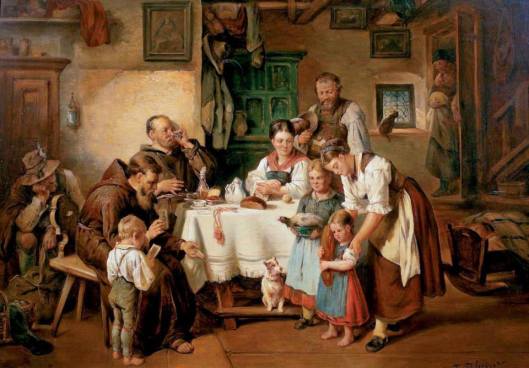
Woman’s chief sphere is home, and one of her principal duties is the care of the household, to manage a family and the domestic affairs. For this purpose she is endowed with executive and administrative talents. She it is that makes home so cheerful and bright, so sweet and attractive, that there is no place like home. There it is that she is really great, noble, almost divine. What a majestic kingdom for woman to reign in is home! Indeed, a woman nowhere looks more lovely, more truly great, more fascinating, and more really beautiful and useful than in her own house, surrounded by her own children, giving them what instruction she is capable of, or devising some plan of intellectual entertainment. Depend on it, that this is the grandest position in this world for a woman, and this home-audience is nearer and sweeter to her affectionate heart than all the applause and flatteries that the outer-world can bestow. It is not in the court-room, the pulpit and rostrum, but it is among the household congregation that woman’s influence can achieve so much, and reign paramount. There her influence is so great that the Holy Ghost says: “A wise woman buildeth her house; but the foolish will pull down with her hands that also which is built.” (Prov. xiv., 1.) “He that possesseth a good wife, beginneth a possession. She is a help like to himself, and a pillar of rest.” (Eccles. xxxvi, 26.) ” Happy is the husband of a good wife; for the number of his years is double. A virtuous woman rejoiceth her husband, and shall fulfil the years of his life in peace. A good wife is a good portion, she shall be given in the portion of them that fear God, to a man for his good deeds. The grace of a diligent woman shall delight her husband, and shall fat his bones. Her discipline is the gift of God. A wise and silent, a holy and- shamefaced woman is grace upon grace, and no price is worthy of her.” (Eccles. xxvi.) “Blessed is the man that dwelleth with a wise woman.” (Eccles. xxv., 11.)
“Who shall find a valiant woman? Far, and from the uttermost coasts is the price of her. The heart of her husband trusteth in her; and shall have no need of spoils. She will render him good, and not evil, all the days of her life. Strength and beauty are her clothing. She has opened her mouth to wisdom, and the law of clemency is on her tongue. She has looked well to the paths of her house, and hath not eaten her bread idle. Her children rose up and called her blessed; and her husband, and he praised her.” (Prov. xxxi.)
Indeed, her presence lights the home, her approach is like a cheering warmth; she passes by and we are content; she stops awhile and we are happy. To behold her is to live; she is the aurora with a human face. She makes an Eden of the house; Paradise breathes from her; and she communicates this delight to all, without taking any greater trouble than that of existing beside them. Is it not a thing divine to have a smile which, we know not how, has power to lighten the weight of that enormous chain which all the living in common drag behind?

Dignity, Authority, And Duties of Parents, Ecclesiastical and Civil Powers-Their Enemy
~Father Michael Müller
Leave a Reply