
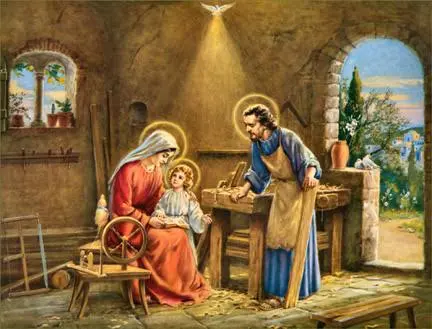
The best way to bring up holy children is to set them a good example. “Words move,” says the well-known proverb, “but examples attract.” Men, says Seneca, place more implicit faith in what they see than in what they hear. Children are like apes. They easily imitate what they see. If they notice in their parents great respect and love for God and the Blessed Virgin Mary, for the priest and religion, they, too, soon commence to honor and love God, the Blessed Virgin, and everything sacred.
In the book ” The Irish in America,” by J. Fr. Maguire, we read the following:
There is not a priest of any experience in the American mission that has not met with the most interesting proofs of the holy flame burning in the hearts of Irish Catholics far removed from a church. The delight of these good people at a visit from one of their own clergymen — the Sogarth aroon — is indescribable. A friend, who now holds an eminent position in the ministry, told me how he was affected by the feeling exhibited by an Irish woman whom he visited, as much by chance as design, in the course of a missionary tour whose extent might be counted by hundreds of miles. He came to a house in the midst of the woods, but surrounded with every appearance of substantial comfort; and on entering through the open doorway he found a number of young people in the principal apartment. He was welcomed, but coldly, by the elder girl, who told him that “mother” was somewhere about the place with the boys. The clergyman asked some questions, which at last were replied to with evident restraint; but when he said he was a Catholic priest — and an Irish priest, too — there was an end to coldness and reserve. The girl had taken him for a preacher, of one of the many sects to be found in every part of America, and her courtesy was rather scant in consequence. “Oh, Father, don’t go ! — I’ll run and fetch mother! ” cried the girl, as she ran out to impart the joyful tidings to her parent; the priest in the meantime establishing friendly relations with the younger children. Soon were hurried steps heard approaching the house, and one voice, half choked with emotion, saying: “Mary, Mary, darling, are you serious? — is it the priest? — is it really the priest?” answered by that of the daughter with: “Yes, mother dear, it is the priest, sure enough.” In rushed a woman of middle age, her arms outstretched, and her face flushed with strong excitement. Falling on her knees on the floor, she exclaimed, with an accent of passionate supplication, that thrilled the priest to his heart — “Oh, Father! for the sake of God and his blessed Mother, mark me with the sign of the Cross!” Her face, though merely comely at best, was positively beautiful in its expression, as her pious request was complied with. The example was contagious. The entire family were at once on their knees, and — “Me, Father! — don’t forget me, Father! — Father, don’t forget me,” from the youngest, showed how the mother’s spirit pervaded her children. It was some hours before the good woman’s excitement subsided; and as she busied herself to do fitting honor to her guest — whom she assured she would rather see in her house than the king on his throne, or the president himself — she constantly broke off into pious ejaculations, full of praise and thanks. The priest remained long enough under her hospitable roof to celebrate Mass — which to her was a source of joy unspeakable, as she looked upon her dwelling as sacred from that moment — and to strengthen by his instruction the strong impression already made upon the minds of her children by their pious mother. This good woman’s husband had been carried off by malignant fever, leaving to her care a large and helpless family; but, as she said, “God gave her strength to struggle on for them,” and she did so, bravely and successfully, until the eldest were able to help her, and abundance and comfort were in her dwelling. For many years she had not seen the face of a priest, or entered the door of a church; but the faith was strong in her Irish heart, and every morning the labors of the day were blessed by the prayers of the family, who repeated them as regularly before they retired to their un troubled rest; and on Sundays the prayers of Mass were read, and the litanies were recited. Thus was the faith kept in the midst of the forest, until the time came when the church was erected, and the congregation knelt beneath its sacred roof; and the voice of praise blended with the swelling peal of the organ, and the exiles really felt themselves “at home” at last.
If children never hear an unbecoming word from the lips of their parents, they, too, will be on their guard against improper expressions; if children see that their parents are always anxious to go to Mass, to listen to the Word of God, to receive the sacraments frequently, to read pious books, they will easily follow their example in these points; if they perceive in their parents great respect and love for their grandfather and grandmother, they will say to themselves, It is thus that we too must always treat our parents; if children observe that their parents are sober and temperate, never quarrel with each other or with their neighbor, never cheat any person, never speak ill of any one, willingly undergo hardships, and patiently suffer crosses and trials and the contempt of men, make no great account of earthly goods, have more care of the salvation of their souls than of the riches of this world, they also will practise these virtues and make them their own. Long after the death of parents, children are often heard to say: “Such and such a thing was taught us by our father, and such and such a thing by our mother.”
Holy Scripture bestows great praise upon Josias for having done what was right in the sight of the Lord, and having walked in all the ways of David his father. Here we may ask, why is it that Holy Scripture, when speaking of pious Josias, also mentions his father David? It is to show that the good example of David, who lived in the fear of the Lord, was the cause of the piety of his son Josias.
Ah ! how true is what St. Alphonsus says, viz: “Holy parents bring up holy children.” By her incessant prayer and tears, St. Monica obtained for her son Augustine the grace of conversion, — of becoming from a great sinner a great saint. St. Catharine of Sweden became a great saint. Why? She was the daughter of St. Bridget. St. Henry the emperor became a saint. Why? He was the son of St. Stephen, king of Hungary. St. Louis, king of France, became a saint. Why? He was the son of Queen Blanche, who was a great servant of God. St. Aphonsus became a great saint. Why? Because, as he himself says, his mother was a holy lady, living in her house as if in a convent. She daily said the office of the Church, and kept the fast-days and days of abstinence, even to the age of ninety years. St. Gregory had several brothers and sisters who died in the odor of sanctity. What was the cause of their holy lives? They had a holy father and a holy mother. I repeat once more the words of St. Alphonsus: “Holy parents bring up holy children.”

Dignity, Authority, And Duties of Parents, Ecclesiastical and Civil Powers-Their Enemy
~Father Michael Müller
Leave a Reply