
“I have yet many things to say to you, but you can not bear them now.” —St. John xvi. 12.
SYNOPSIS.—Heresy and Unbelief contradicting each other in reproaching the Church; the one claiming the Church is making new doctrines; the other complaining that she isn’t. The Church truly progressive, without changing her doctrines.
I. The Holy Ghost causing progress in knowledge of the teachings of Christ. The Apostles did not fully understand the words of Our Lord until the Holy Ghost taught them. Progress in Christian Practice. Progress through the learning of the Fathers of the Church, through Councils and the Popes.
II. The Holy Ghost causing progress in the practice of Christ’s teaching. Christian charity. The evangelical counsels. Fasting. The Church not an enemy of progress.
My dear brethren, among the reproaches charged against the Church by her enemies there are two which contradict each other. Heresy reproaches her with making new doctrines, and that for this reason she is no longer the Church of Christ. Unbelief, on the other hand, reproaches her with exactly the opposite, and finds fault because she steadfastly holds to the doctrines of her origin; that she must, therefore, be obstinate and an enemy to progress. Both are unjust reproaches. For it is not the Catholic Church which has departed from the teaching of Christ. She has added nothing new, but heresy has rejected many of the teachings and means of grace of Christ, which she continues to preach. The Church is not an enemy to progress, but she is an enemy to a return into the darkness of paganism, of vice, and of the gross ignorance of religious things, which she would countenance if she turned her back upon the light of the Gospel, if she rejected the teachings of divine revelation, as unbelief wants her to do. That the Church knows of a progress is taught by her divine founder Himself in today’s Gospel in these words: “I have yet many things to say to you, but you can not bear them now. But when He, the Spirit of Truth, shall come, He will teach you all truth.” The progress of the Church is ordained in these words in so far as:
I. The Holy Ghost will bring about that the teaching of Christ shall be ever better known and understood.
II. The Holy Ghost will cause an ever-increasing influence of Christianity upon mankind.
These two points shall be the subject of our consideration. May the Holy Ghost enlighten us and guide us deeper into the holy truths of faith.
“I have yet many things to say to you, but you can not bear them now.” Thus speaks the Saviour to the Apostles. But why could they not bear them then? The Apostles themselves gave the answer. For in spite of the presence of Jesus and of His divine teaching, they still showed, until the Ascension of the Lord, a disposition which was so worldly as to render them incapable of fully comprehending the divine mysteries. They even asked, shortly before the Lord’s Ascension: “Wilt thou at this time restore again the kingdom to Israel?” (Acts i. 6.) They could even then relinquish the hope for a powerful earthly kingdom of the Messiah. That they should recognize and renounce such fallacies was to be the work of the Holy Ghost within them. As a practical result of the descent of the Holy Ghost upon them, they immediately received the essential knowledge of the nature of the Messiah’s kingdom, promised by Jesus, as well as of the necessity of His passion and death, which was before so difficult for them to understand. Jesus had spoken of the one fold, into which He would also lead all his other sheep. (John x. 16.) Upon more than one occasion He had repeated this, in particular when he spoke of those who should come from the east and the west and sit down with the patriarchs (Matt. viii. 11), as also in the parable of the great supper (Luke xiv. 16) ; and yet it required, even after the coming of the Holy Ghost, a particular revelation to Peter in the story of the clean and unclean beasts (Acts x. 11) to induce him to receive the heathens into the Church without their passing through Judaism.
And as with this teaching, so it was with many others. The Apostles only attained to a full comprehension of the same through the Holy Ghost. Although Jesus had spoken repeatedly of three Persons in one Godhead, as, for instance, in His many promises of sending the Holy Ghost, and in His command to go and baptize (Matt. xxviii. 19), the Apostles were certainly wanting at that time in the knowledge of this mystery, as we find it defined by St. John in the beginning of his Gospel in the words: “For there are three that give testimony in heaven; the Father, the Word, and the Holy Ghost: and these three are one.” (I. John v. 7.)
Jesus speaks here and there of the rejection of Judaism, its sacrifices and its customs; even the prophets, like Malachias, had already done this, and yet we see the Christians of the first Christian community still visiting the Temple. Only by the widespread growth of Christianity and its more visible formation did the Christians forsake this habit. All these and similar matters are referred to in the words of our Lord, that the Apostles could not bear them, that for them they then had no understanding. But they were there to receive it, and they did receive it through the operation of the Holy Ghost after the departure of Christ. They arrived at a better understanding of the teachings of Jesus, and this was some of the progress of Christianity.
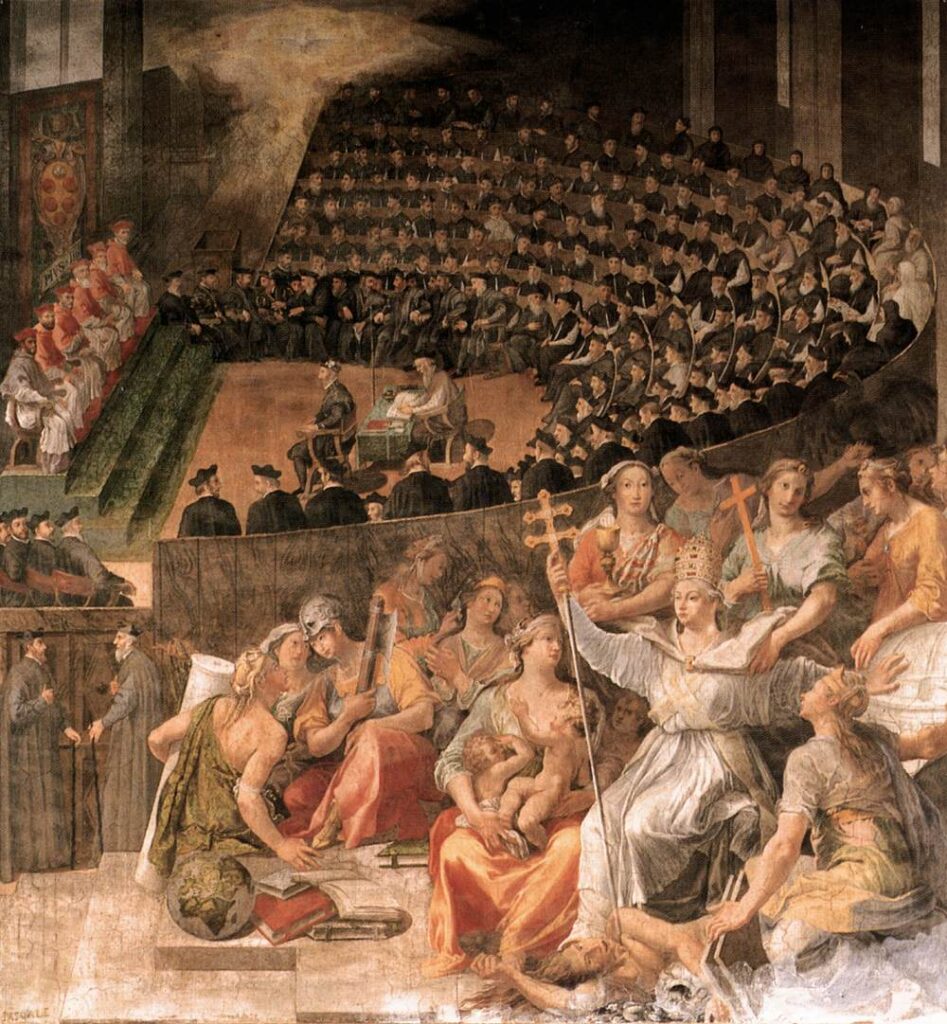
But this progress was not to end with the death of the Apostles; it was to continue throughout the centuries. Revelation ceased more or less with the Ascension of the Lord. But a much clearer knowledge and an ever-increasing development of these doctrines took place. It is absolutely unjust, it is even calumny against the Church, to reproach her with formulating new doctrines of faith. What she has done was and is only to demonstrate more clearly and to bring more plainly to human comprehension the revealed truths. How brilliantly was this accomplished, for instance, by the voice and the pen of the Holy Fathers of the Church. Although they were not the voice of the Church, yet the voice of the Church, in speaking through general councils and the Popes, agreed almost invariably with the voice of the Fathers of the Church. How enlightening was such an explanation of the divine revelation, as opposed to the teachers of heresy, who appeared as early as the end of the first century. The necessary condemnation by the Church of their heretical teachings brought a more detailed statement of the true teaching with it, and the Church gladly availed herself of the cooperation of the inspired Fathers of the Church. The existence and the qualities of God, His relations to the world through creation and redemption, the most holy Trinity, divine grace and its relation to our free will—these are all subjects which are taught in divine revelation, but in consequence of the magnitude of its mysteries for our poor and imperfect understanding they underwent many misstatements at the hands of heretical teachers and their adherents. To protest against this, and to proclaim the truth in opposition to them, and to define it as far as possible in human language, that was the work of the Holy Ghost in the office of instructor of the Church. This was accomplished through all the centuries up to the overthrowing of the heresies of modern times by the councils of Trent and of the Vatican in Rome. In the ever-clearer definition of the truth consists the progress of Christianity; it is the fulfillment of the promise: “But —when he, the Spirit of truth, shall come, he will teach you all truth.”
And still in another sense Jesus could say, “I have yet many things to say to you, but you can not bear them now,” namely, in reference to the influence of the teaching of Jesus upon conduct and morals. Here, also, we speak of progress of Christianity. Jesus gave an intimation of this influence by the parable of the leaven. But in what manner this parable should be fulfilled the Apostles certainly had a much better conception a few years after the Ascension of the Lord than at the time when they heard it. They understood, then, how, before the coming of the Holy Ghost, they had not been able to hear what Jesus had yet to say to them but had not said. The commandment of exercising charity was already known to them from the Old Testament. How often, besides, had not Jesus impressed it upon them. But what great fruit this great commandment was to bear through the Holy Ghost they had yet to witness. How greatly the Apostles, enlightened by the Holy Ghost, were influenced in all things by Christian charity is shown in their letters. The many precepts they give therein upon the mutual obligations of married people, parents and children, masters and servants, those high in authority and subjects, are all founded upon charity. How severely James censures the pride and luxury of the rich; how Paul impresses upon the members of his community the obligation of supporting their needy brethren in the faith by taking up collections for them. We admire, also, the voluntary sharing of property in the Christian community at Jerusalem; and we see therein a development of Christianity as the Apostles understood it, while before they had a very imperfect idea of all these things. The evangelical counsels were recommended by Christ and practiced by the Apostles according to the words of St. Peter: “Behold, we have forsaken all things and followed thee.” And the observance of the evangelical counsels by the numerous religious orders of our own days, to the immeasurable benefit of the Church and of mankind, is a visible sign of the progress of Christianity which the Apostles could not comprehend when Jesus said to them: “I have yet many things to say to you, but you can not bear them now.” Then again let us consider fasting. How completely it is founded upon the teaching and example of Jesus. But its practice, its extension, and its restrictions, regulated and ordered to suit time and place, and to suit the ability and conditions of mankind, is the prerogative of the Church, under the guidance of the Holy Ghost.
We might mention many subjects upon which we could make the same observations. But you will admit that what we have said is amply sufficient to make it clear that, though the Catholic Church is unchangeable in her doctrines of faith and morals, she is in no way the enemy to the right sort of progress. Let us be firmly convinced on this point. Not a word of divine revelation has been rejected or changed by the Church; we will neither reject, nor be deprived of, a syllable of it. But for progress away from heresy and unbelief, which are a step backward from light into darkness, we are grateful. We willingly commit ourselves to the guidance of the Church, wherein the Holy Ghost fulfils the promises of Christ: “But when he, the Spirit of truth, is come, he will teach you all truth, he shall glorify me; because he shall receive of mine, and shall shew it to you.” (John xvi. 13, 14.) Let us allow ourselves to be conducted by the hand of the Church through this Holy Spirit ever deeper into the truths of faith; there we shall find contentment and joy, until faith is at last changed into the vision of God face to face. Amen.

Taken from the Sermons of the Cure of Ars
Leave a Reply