
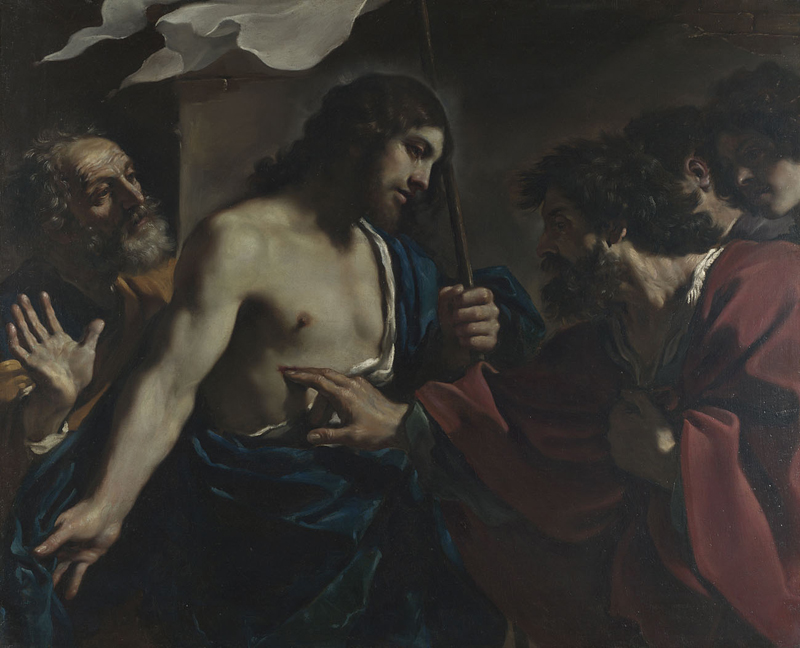
“Blessed are they that have not seen and have believed.”–John 20.
In today’s Gospel Christ says to Thomas: “Blessed are they that have not seen and have believed,” whilst at another time we find Him saying: “Blessed are the eyes that see the things which you see.” What is the explanation of this seeming contradiction? Were not the eyes of Mary and of Joseph blessed? were not the eyes of all who beheld our Saviour in the flesh blessed? Yes, but only in so far as they believed in Him and regarded Him with eyes of faith, listening to His divine lessons, and imitating His holy example. For does He not say again: “Blessed are they that hear the Word of God and keep it in their hearts?” Of what avail was it to the Scribes and Pharisees to see and hear our Lord, since they hardened their hearts against Him? Of them and such as them He said: “If I had not come, and spoken to them, they would not have sin; but now they have no excuse for their sin.”
If, then, the words: “Blessed are they that have not seen and have believed,” are to be realized in us, our lives must agree with our faith. I shall today endeavor to answer the question:
In what relation does faith stand to our spiritual life? O Mary, thou who didst see and believe, but didst live according to this belief far exceeding any saint or angel, pray for us that we may bear witness by our lives to the faith we profess! I speak in the most holy name of Jesus, to the greater glory of God!
“The just man,” says St. Paul, “lives by faith.” To know whether this text applies to us, we have but to look at the chief properties of life, and we shall be able at a glance to see how far faith influences our daily conduct, how far it is a vital force within us. A living man breathes. This breathing is an emblem, a figure of the influence of sanctifying grace, that vivifies our souls, enabling them to perform works meritorious in the sight ot God. As St. Paul assures us, we could not of ourselves pronounce the name of Jesus in a meritorious manner. To do so the assistance of divine grace is needed, of sanctifying and of actual grace, the latter coming to our aid as soon as we have reached the years of discretion. This action of grace in the soul is the breathing and pulsation of the spiritual life.
He who lives, sees. He sees the bodies by which he is surrounded, he knows that they exist, he can distinguish their various qualities, and judge how far he can use them towards any aim or object he has in view. Now, faith does the same for our souls. The mind of the unbeliever is obscure, he does not know why God created him, why the universe was called into existence. The believer, on the contrary, sees the whole universe like an open book illumined by the light of faith; he sees himself created by God, for God, destined, after serving his Creator during this short life, and using all things of earth for that sole aim, in a future life to be made a partaker of the infinite enjoyments and the infinite glory of God Himself. The lives of the saints teach us what strength and zeal the knowledge of this sublime destiny can impart.
He who lives, hears. A lively faith gives sensitive ears to the soul. The teachings, the promises, the menaces of Holy Writ are listened to readily by the man of faith. Countless whisperings of the Holy Spirit are caught by his attentive ear, and so he is at once informed of his duties towards God and animated to fulfill them. What does the infidel know of whisperings of the Holy Ghost? Deafened by the noise of the material world, his spiritual senses are clogged and he remains unconscious of the voice that is ever warning men to follow Jesus and to serve their God. The promises and menaces of revelation are alike void of effect when they reach only the ear of the body and are not heard by the soul. Different, indeed, is the state of him who is animated by a lively faith. How quickly he hears the inspiration from on high! In the hours of temptation, how cheering the promise of eternal happiness, how terribly plain the menaces of eternal woe!
He who lives speaks, enjoys, grows. Faith gives to the spiritual life speech, pleasure, development. “I have believed, therefore have I spoken,” confessed David, and with him all who have living faith. St. Bernard says: ” Nothing pleases me, nothing interests me to which the name of Jesus is not united.”
Why do we possess the gilt of speech? why has God given us this power of communicating our thoughts to our fellow-men, if not that we may use this gift to draw men to Him by persuasion? When the Holy Ghost appeared on Pentecost in the shape of tongues of fire, it was not upon the heads of the Apostles only that he rested, but upon the heads of laymen and women too, thus to signify that all Christians should be inflamed with the desire of helping by word and work to spread the kingdom of Christ throughout the earth. To be able to do this all must be well grounded in the doctrines of our holy faith. Let this be an admonition to Catholics of their duty (a duty which is incumbent upon all, especially in our day) to read good books and pay careful attention to sermons, that being thus well acquainted with the foundations of their faith they may help both to defend it against its enemies and to enlighten their countrymen who wander in the darkness of unbelief.
Let us see now how faith gives rise to enjoyment, growth, development in the spiritual life of the soul. Is it not faith that enables us to participate worthily in the sacraments? What but faith leads us to the sacred tribunal of Penance, and to the holy table where Jesus Himself is our food? The more a man’s soul is enlightened by faith, the more does he realize the weaknesses, the imperfections, the miseries of his poor nature; and consequently the more comprehensive and frank is his confession, the more ready his disposition to do penance, the more steadfast his purpose of amendment. How much greater, then, must be the grace of this sacrament in such a man than in one whose belief is neither lively nor earnest? What shall I say, then, of the effects of this virtue on the soul that humbly approaches Holy Communion? The heart filled with lively faith can not but be aroused and inflamed at the thought of Who it is that thus deigns to come to us. Faith makes us feel and realize fully the personal presence of Christ within us, and thus binds us anew to His holy Church by kindling in us the desire of living as true children of so loving a Master! and finds expression in the deep prayer of adoration that fell from the lips of St. Thomas: “My Lord and my God!”
Blessed indeed are those who see not, but who believe, and live according to their faith! Amen!
Leave a Reply