
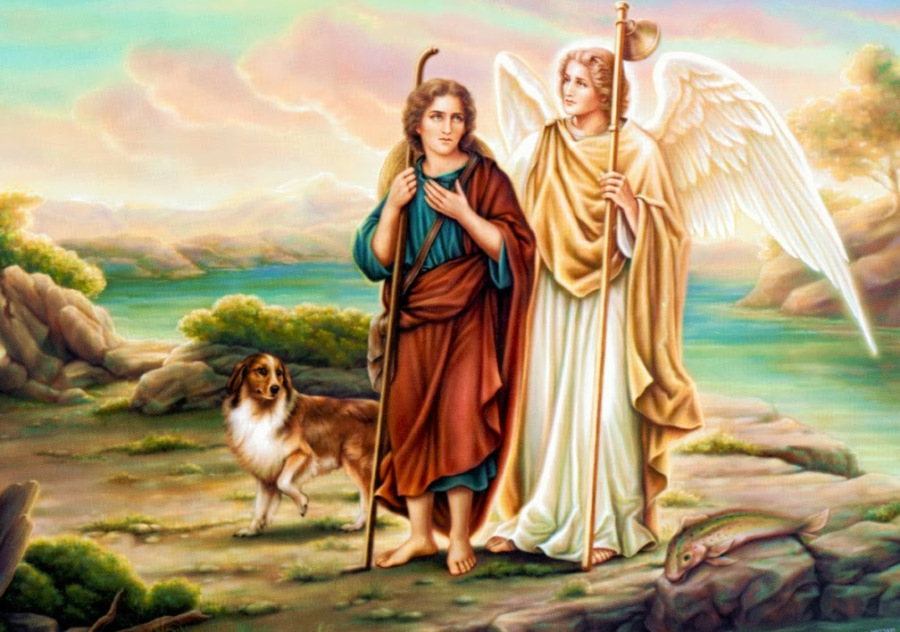
” I am the Angel Raphael, one of the seven who stand before the Lord.”
The history of Tobias, one of the most beautiful narratives of the Old Testament, teaches us many lessons. There we find a charming picture of home-life. The father of the family is at once the example and teacher of virtue to his young son ; the son, a model of filial devotion to his aged parents, succoring them in their need, submissive to their will, delighted to give them pleasure.
The life of the family is full of peace. Even in affliction they recognize the finger of God, and His blessing rests upon them. He is the sunshine of their home. To serve Him — to keep themselves free from sin — is their chief care. When, there fore, it became necessary that the younger Tobias should make a long journey, the first thought of his father was to find him a suitable companion. He would not trust his child to the guardianship of every man. He felt the necessity of great care in the choice he made. Such a choice is indeed not a trifling matter, not so unimportant an affair as some seem to think it ; the happiness of a whole lifetime, perhaps even eternal salvation itself, may be at stake. Young people especially are very susceptible to the influence of those who are about them. They are open-hearted, unsuspecting, too ready often to give their confidence and friendship to those unworthy of either. They are slow to abandon those upon whom they have bestowed their regard, unwilling to believe evil of them because of their affection for them. And so the danger to their virtue is very great when they fall into bad company, their ignorance of the world and their guilelessness leaving them open to many temptations.
The bad companion is he who is trying to rob us of our virtue — to rob us of the best we possess.
Virtue is a precious thing. It is a treasure beyond price. To have virtue is to possess nobility of soul, elevation of mind, a close likeness to’ God. To have habits of virtue marks us out as true men, men who have made their animal nature subject to reason through God’s grace. Virtue is not acquired in a day. The getting of it means work, constant work for a time, perhaps a long time ; but it is worth all it costs. When we have virtue, we have something of a great value ; and because it is so valuable it must be carefully guarded lest we lose it, for we may be robbed of our virtue as well as of our money.
The bad companion wants to destroy our innocence ; he wants to disturb our peace of soul ; he wants to unman us, to make beasts of us. Where are these bad companions ? How shall we know them ? “By their works you shall know them.” You shall know them when you hear their filthy speech, when they make their dirty jokes and tell their smutty stories. You shall know them when they invite you to low drinking saloons, to places where purity is lost ; when they tell you how to make money at the expense of honesty ; when, in a word, they suggest evil to you. Flee from them ; they are robbers ; they are worse : they are murderers ; they seek to take the life of your soul.
The Angel Raphael on the other hand, teaches us the offices of a good companion. We find him guiding his young charge, warning him of dangers, instructing him how to overcome difficulties. He is by his side in the hour of need ; his counsel is always at his service ; his advice is good ; his example is good. He is constantly striving to advance the best interests of Tobias and to further the object of his journey. This is true friendship ; this is right companionship. It is unselfish, conscientious endeavor to promote the friend’s welfare. Young people, find yourselves a Raphael, but trust not every man.

Leave a Reply