
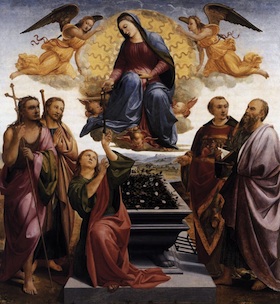
We read in the life of St. Stanislaus Kostka that, being visited by sickness in Vienna, Mary appeared to him with the Infant Jesus upon her arm. The divine Child embraced the holy youth, while Mary told him distinctly that he should leave the world and enter the Society of Jesus. Without hesitation he obeyed, and traveled on foot all the way to Rome, where St. Francis Borgia received him into the Society.
But God had decreed that ere long he should set out upon another journey, and travel from Rome to Heaven. He was still in the morning of life, in the first bloom of early youth, when, before the year which had witnessed his entrance into religion elapsed, on the Feast of the Assumption, his pure soul winged its flight to God. What shortened his days and burst the bands which bound his soul to earth, was the ardor of his desire to behold Mary in heaven. He wrote to her in terms of glowing love, begging her to take him from this world, and to obtain for him the favor of celebrating the approaching feast of her glorious Assumption in the company of the angels and of the saints.
Mary heard his prayer. He died on the morning of her feast. Mary herself came to bring him with her to Heaven. Beloved in Christ, you may ask: What filled the heart of St. Stanislaus with such great longing to see Mary in heaven? It may be worth our while today to answer this question.
O Mary, Mother of fair love, crowned Queen of Heaven, may our longing to see you in Heaven so sanctify our lives that we may at an early day celebrate with St. Stanislaus the feast of your Assumption! I speak in the most holy name of Jesus, for the greater glory of God!
St. Stanislaus longed for heaven. Great saint, we share that desire! Many are the reasons which inspire us with disgust for this world and excite in us a longing for heaven.
First, in regard to the exterior world in general and the life which we live, many long and weary years has the earth groaned under the curse of sin. There are indeed here below, even after the gates of Paradise are closed against us, many beautiful countries; but all men can not live there, and those who do, grow accustomed to the beauty which surrounds them and find it monotonous and tame.
Oh, how I long to behold the delights of the Lord in the country of the living–to behold what a God Who is infinite Beauty and Blessedness, and at the same time omnipotent, is able to create! Here on earth are men who, though wide tracts of land lie unused, can not call one foot of ground their own. O Mary, I long to leave this inhospitable country to enter heaven, there to exclaim: “Heaven is mine! All is mine!”
Here, according to the curse pronounced on man–“In the sweat of thy brow shalt thou eat thy bread”–he is obliged to earn his bread by weary toil, for that curse is fulfilled in every one to a greater or less degree.
O Mary, I desire to go home to heaven! Here is labor–there is reward; here is toil–there is rest; here is anxiety–there is peace. Here is one constant vicissitude–today rich, tomorrow poor; today in health, tomorrow in sickness; today honored, tomorrow despised; today flattered, tomorrow persecuted; today it is life, tomorrow death. In heaven we find rest eternal and perpetual joy. Oh, how I yearn to go to heaven! Here all is perishable–there all is eternal; here is suffering–there is rejoicing.
With what perfect justice, no doubt, could Job exclaim: “Man, born of a woman, liveth but a short time, and is filled with many miseries.” How many thorns of suffering spring up in life from the one single care to provide for one’s self and family! Often, with the most willing heart to labor, a person can even find no employment. To this are added innumerable painful sicknesses, and finally death. Oh, I long to leave this world to go to heaven, where, for ever and ever, no shadow of trouble can ever fall–no rain, no hunger, no thirst, no misery afflict the body–no separation distresses the soul; where no tears are shed; where there is naught but joy–eternal joy.
If we regard the society and the intercourse of men on earth, what a longing after heaven stirs up the heart of man! Oh, what terrible wickedness, servility, and malice, what falsehood and treachery, are found among men in this valley of tears! In heaven there is only the Communion of Saints.
Oh, I desire to leave this sink of moral corruption to enter the society of Angels and Saints–to fly from the company of creatures and enjoy an endless union with God Himself! As long as I live on earth I live in danger of offending God. In heaven it will be impossible for me to commit sin. Oh, thrice happy impossibility! Mary, I desire to leave this world to go to heaven!
If there were no other motive, this alone would be sufficient for a soul inflamed with love of God to long continually for heaven, where never a shadow of temptation or imperfection is to be found, where to displease God is an impossibility. The misery of this world and the happiness of the next was the daily subject of meditation for St. Stanislaus; hence his longing for the abode of the blessed.
But apart from all these motives, there is, for the child of Mary, one motive which, in the abstract, is alone powerful enough to nourish daily–yes, hourly–in our hearts the desire of Heaven. It is the wish to behold there this dear Mother, to offer her our thanks, and to share her beatitude forever. It was, above all others, this motive which so inflamed the heart of St. Stanislaus that it dissolved the fetters which held him to earth, and set him free to fly to heaven on this lovely feast so dear to the hearts of Mary’s devoted children.
Oh, how many reasons have we to long with St. Stanislaus for heaven! For if its general magnificence is so indescribably ravishing, and each dwelling there, each throne, each crown so resplendent with unfading glory, how magnificently will not the mansion, the palace, the throne, the crown shine forth which God the Father, Son, and Holy Ghost, have prepared for the Queen of heaven!
Oh, that I, too, might soon with St. Stanislaus behold them in all their beauty! Heaven is the kingdom of reward, with which nothing earthly can be compared. “Eye hath not seen nor ear heard, nor hath it entered into the heart of man to conceive what God has prepared for His lovers.”
And as to Mary, each act of hers surpasses in merit those of the saints and angels. They are the jewels on her heavenly attire, the gems on her celestial crown.
It is your happy lot, St. Stanislaus, to gaze upon Mary today. Oh, that I too, ere long, may behold her there with you! I long to see Mary, as the mirror of justice, in the abundance of merit which distinguished her, which, from the beginning with her Immaculate Conception, augmented to the day on which her stainless soul departed this life.
I long to see her, to salute her, to thank God with and through her for her great glory and pre-election, and at the same time to see all the graces which she has obtained for me from Him, as the Mother of mercy, as Mother of divine grace. How much I am indebted to her intercession and solicitude for the rescue and sanctification of my soul!
Indeed, I long to enter heaven and to present to Mary my affectionate homage and veneration, my gratitude and love. Only in heaven can this be done to the entire satisfaction of my heart. Here in the land of my exile I can only thank her from afar, surrounded by the assaults of the enemy of salvation–there I will thank her as her rescued child; and not alone my thanks will be offered, for with them will go the ardent gratitude of the whole celestial host.
A heart penetrated with gratitude to God invites, as the Psalmist admonishes us, every creature in heaven and on earth to laud, praise, and thank God. The same may be justly said of our gratitude to Mary the Mother of God. Oh, what a motive to sigh after heaven with the fervent ardor which glowed in the heart of St. Stanislaus! What a joy and privilege, in the company of the Angels and Saints, to laud, praise, and thank Mary!
St. Stanislaus, the Holy Ghost moved thee to direct thy petition to Mary, because that divine Spirit chose thee as a model for youth. We, on the contrary, call upon thee to obtain for us through her the grace to celebrate yet often, but always in a more worthy manner, the Feast of her Assumption on earth, until we shall be called from this land of exile to celebrate with thee in heaven this happy feast, and with all the Angels and Saints rejoice in the possibly highest degree thereat. Amen!

Fr. Francis Xavier Weninger, 1882
Leave a Reply